Blog
October 21, 2026
·6 min readVirtual Try-On for Eyewear: Help Shoppers Choose With Confidence

Otuokon Nsikak
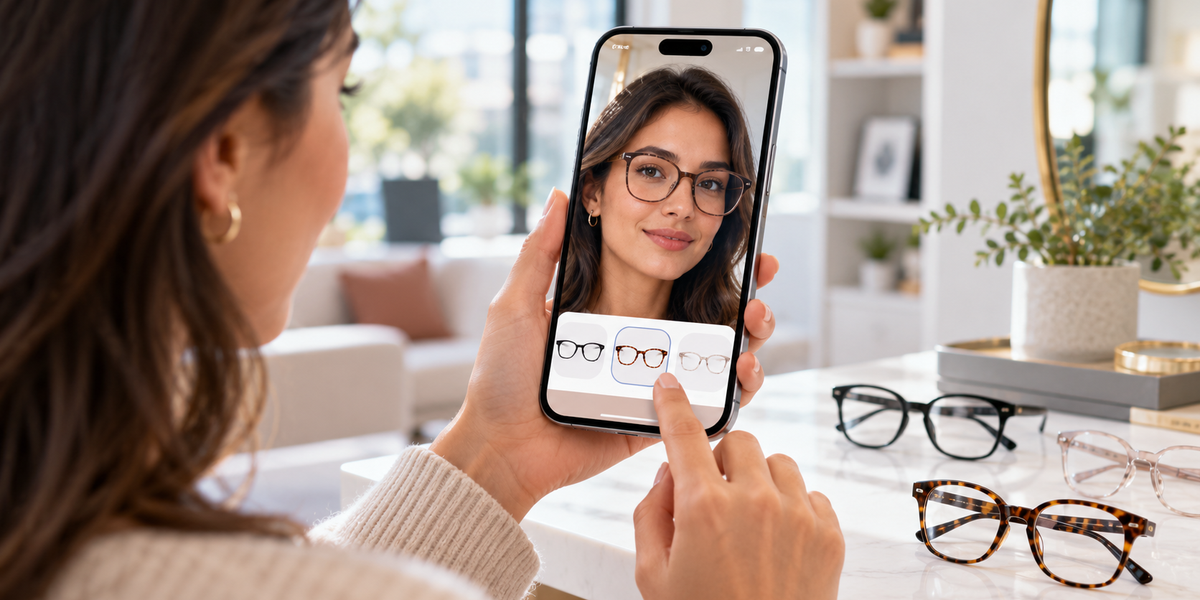
Buying glasses online is harder than buying most products.
A frame can look perfect in a product photo and wrong on a face. Shape, size, bridge width, lens height, and overall presence all change once the product leaves the model and meets a real person.
That is why eyewear is one of the strongest use cases for virtual try-on.
Not because shoppers want a gimmick.
Because they want fewer unknowns before they buy.
The real problem eyewear brands are solving
Most product pages answer:
- What does the frame look like?
- What colours are available?
- What is the price?
They are weaker at answering:
- How will this sit on my face?
- Does this shape suit me?
- Does it look too large, too narrow, or too strong?
- Can I picture myself wearing this?
Those questions create hesitation.
Hesitation creates abandoned carts, support messages, and returns.
Virtual try-on is useful when it helps the shopper move from guessing to seeing.
What virtual try-on for eyewear actually means
In ecommerce, virtual try-on for eyewear usually means one of these:
1. Live face-tracking try-on
The shopper opens the camera and sees frames positioned on their face in real time.
2. Photo-based try-on
The shopper uploads a photo and previews frames on that image.
3. 3D product exploration without try-on
The shopper rotates and inspects the frame in 3D, but does not place it on their face.
For eyewear, the highest-value experience is usually face-based preview.
The product is worn. Appearance is personal. Context is the face, not a room.
That is different from furniture AR, where the key question is often scale in space.
Why eyewear is a natural fit
Eyewear has three commercial traits that make try-on valuable.
1. Appearance is personal
Two people can view the same frame and reach opposite conclusions. Style is not universal.
2. Photos transfer poorly
A campaign model does not solve the shopper’s real question: how will this look on me?
3. Returns are expensive
Frames that look wrong in person create friction for the customer and cost for the brand.
Virtual try-on does not remove every risk.
It reduces one of the biggest ones: appearance uncertainty.
What a strong eyewear try-on experience should do
A useful experience is simple.
The shopper should be able to:
- open try-on from the product page
- see the frame on their face quickly
- compare options without friction
- return to the buying journey without getting stuck
That means the experience should prioritise:
- clear launch language such as “Try on” or “See on your face”
- fast loading on mobile
- stable positioning
- easy switching between frame options
- no forced app download
If try-on is buried, slow, or disconnected from the product page, usage drops fast.
Browser-based try-on vs app-based try-on
For ecommerce, browser-based virtual try-on is usually the stronger path.
App-based flows add friction:
- install another app
- create another account
- leave the product page
- interrupt the purchase path
Browser-based try-on keeps the shopper in the same journey.
That matters because the goal is not maximum technical sophistication.
The goal is more confident product decisions with less friction.
What virtual try-on should not overclaim
This is where brands get into trouble.
Virtual try-on is strongest as an appearance confidence tool.
It should not be positioned as a perfect guarantee of:
- exact optical fit
- prescription suitability
- millimetre-perfect bridge fit for every face
- zero returns in all cases
Those are different problems.
A better standard is clearer and more honest:
Help the shopper understand how the frame looks on them before they buy.
That is still a major improvement over static photos alone.
Where virtual try-on helps most
Eyewear try-on tends to matter more when:
- frames have distinctive shapes
- the brand sells fashion or statement styles
- shoppers cannot easily visit a store
- the catalogue has many similar options
- mobile is a major shopping channel
It may matter less when:
- the product decision is driven mainly by prescription and lens performance
- the shopper already knows the exact model
- the page experience is too slow to complete
Use try-on where appearance creates real hesitation.
How to add virtual try-on without turning it into a project
The practical path for most ecommerce teams is not a custom app build.
It is:
Choose the products where face preview matters
Prepare usable product assets
Publish a try-on experience on the product page
Test the full mobile journey
Measure launches, completions, and next actions
Expand from evidence
A pilot on a focused set of frames is better than a full-catalogue rollout with no learning.
What to measure
Vanity metrics are not enough.
Track:
- how many shoppers launch try-on
- how many complete the experience
- whether try-on users continue toward cart or purchase
- whether size and style support questions change
- whether certain frame types get more value from try-on than others
If people launch but do not complete, the experience has friction.
If they complete but do not progress commercially, the experience may be interesting without answering the real objection.
Where SwiftXR fits
SwiftXR is built for publishable product experiences on the web.
For eyewear brands, that means helping shoppers explore products through interactive experiences on the pages where they already buy, including browser-based virtual try-on flows that do not force an app download.
The commercial point is not “we added face tracking.”
The commercial point is:
shoppers can see how the frame looks on them before they decide.
With SwiftXR, teams can create and publish interactive product experiences, place them on ecommerce pages, and keep the path to purchase intact.
Start free: https://swiftxr.io/users/signup
A practical rollout approach
Do not begin with every SKU.
Start with:
- best sellers with high hesitation
- new seasonal frames
- styles that look very different on different faces
- products that generate repeated “how will this look on me?” questions
Frequently asked questions
What is virtual try-on for eyewear?
It is a product-page experience that lets shoppers preview frames on their face using a live camera or photo, so they can judge appearance before buying.
Is virtual try-on the same as size recommendation?
No. Size recommendation estimates fit. Virtual try-on helps with visual appearance and style confidence.
Do customers need an app?
They should not. Browser-based try-on is usually the lower-friction option for ecommerce.
Can virtual try-on work for sunglasses and optical frames?
Yes. Both can benefit when appearance and style confidence affect the buying decision.
Should try-on replace product photography?
No. Photography still sells style and brand. Try-on supports personal confirmation.
How should brands start?
Start with a small set of high-hesitation frames, publish try-on on the product page, measure usage and buying progression, then scale.
The point
Eyewear shoppers are not only choosing a product.
They are choosing how that product will look on them.
Photos can inspire.
Virtual try-on can confirm.
When the experience is fast, browser-based, and built into the product page, it becomes a practical buying tool rather than a novelty feature.
Do not ask shoppers to imagine the frame on their face if you can help them see it.
Start free with SwiftXR: https://swiftxr.io/users/signup