Blog
October 19, 2026
·8 min readDo You Need 3D Models Before You Start?

Otuokon Nsikak
Most ecommerce teams stop before they begin for the same reason.
They assume 3D and AR only work if a full set of production-ready models already exists.
That belief is expensive. It delays pilots, keeps product pages flat, and leaves the buying decision stuck in photographs that cannot answer scale, form, or presence.
So the real question is not “Do we have 3D models?”
It is:
What do we need to publish a useful experience for the shopper, and how quickly can we get there?
Sometimes that starts with existing models.
Sometimes it starts with product photos.
Sometimes it starts with one clean SKU and a pilot, not a catalogue rebuild.
The short answer
You do not always need finished 3D models before you start.
You do need a clear path from the assets you already have to an experience a shopper can use.
There are three common starting points:
You already have 3D models
CAD files, GLB exports, agency assets, configurator meshes.
You have strong product photos, but no models
Catalogue images, pack shots, studio photography.
You have neither reliable models nor clean source images
In this case, the first job is asset quality, not AR launch.
SwiftXR is most useful in the first two cases: publishing interactive 3D and browser-based AR experiences from models you have, or from image-led workflows that produce something publishable.
Why teams overestimate the barrier
3D has a reputation problem.
People associate it with:
- specialist software
- long production cycles
- high agency costs
- technical handoffs that never quite finish
That reputation was earned in older workflows. It is less accurate for modern ecommerce publishing.
Today, many teams can:
- upload an existing GLB
- prepare a model from a cleaner photo-based process
- publish a viewer or AR experience without building custom WebXR
- test on a small set of products before expanding
The barrier is often not technology.
The barrier is assuming the project has to start at full catalogue scale.
Starting point 1: You already have 3D models
This is the fastest path.
If your products already exist as GLB, GLTF, or convertible 3D files, you are closer than you think.
What still matters:
- file weight for mobile
- clean materials
- correct scale
- a stable default camera
- a simple way to launch AR where relevant
Having a model is not the same as having a product-page experience.
A file becomes useful when a shopper can open it, understand it, and continue toward purchase.
Best fit for:
- furniture and home products with CAD origins
- brands already working with 3D agencies
- manufacturers with engineering or design assets
- teams that previously commissioned models and never published them
If the models exist and sit in folders, the next step is publishing, not more production debate.
Starting point 2: You have product photos, not models
This is the most common ecommerce reality.
Teams have catalogues full of images and almost no web-ready 3D.
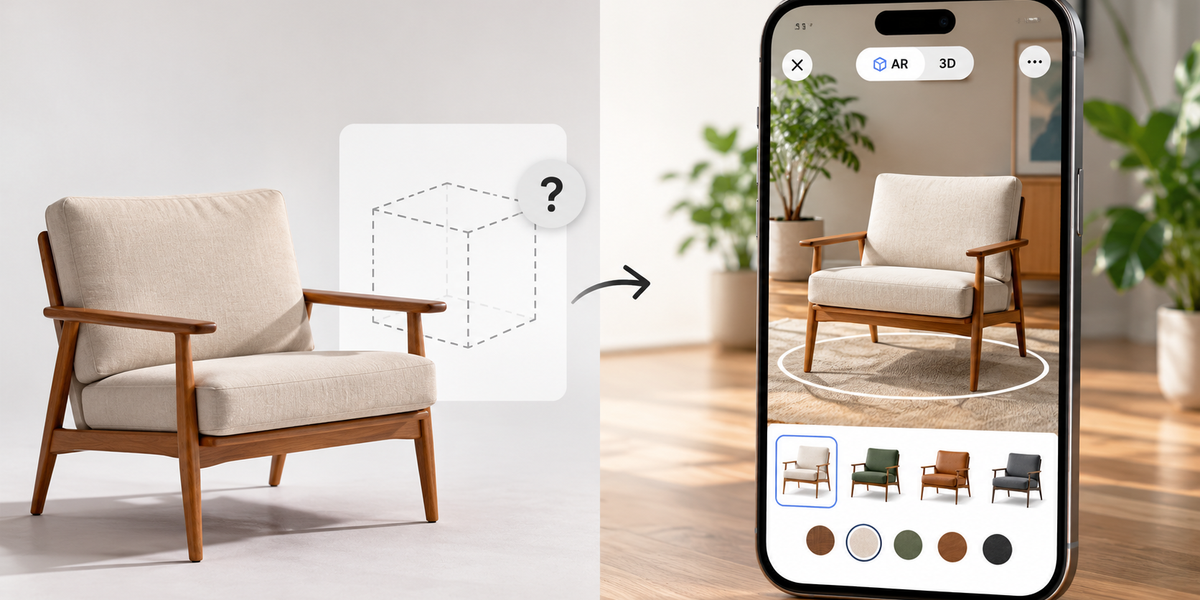
Image-to-3D and image-to-AR workflows exist to reduce that gap.
They are not magic. They are a faster entry point.
A photo-led path can work when:
- the product silhouette is clear
- lighting is even
- the product is fully visible
- the main buyer question is shape, scale, or presence
- you are willing to review quality before publishing
A photo-led path is weaker when:
- materials must be exact
- hidden sides matter a lot
- the product is highly reflective, transparent, or soft-goods complex
- you need precise engineering fidelity
In other words, photos can get you started. They do not automatically replace controlled 3D production for every SKU.
Best fit for:
- early pilots
- decor and lifestyle objects
- packaging and form-led products
- catalogues where coverage speed matters more than perfect material accuracy
This is also where SwiftXR’s publishing layer matters. Generating something is only half the work. The commercial win comes when the result becomes an experience on the product page.
Starting point 3: Your source assets are not ready yet
If product photos are messy, incomplete, or heavily styled in ways that hide the object, start there.
AR cannot rescue a weak source.
Before any conversion workflow, improve:
- clear product-only shots
- consistent lighting
- full visibility of the item
- accurate colour
- known dimensions where scale matters
This is not a delay tactic. It is quality control.
A weak source creates a weak experience, and a weak experience trains your team to believe 3D “doesn’t work.”
What you actually need before a useful pilot
You do not need a perfect catalogue.
You need enough to test one commercial question.
Minimum viable start:
- 5 to 10 products where shoppers currently hesitate
- one clear buyer question per product, such as scale, form, or appearance
- source assets good enough for a readable result
- a product-page placement plan
- a way to measure launches, completions, and next actions
That is enough to learn.
Full catalogue conversion can wait until the pilot shows what is worth scaling.
When you should wait for proper 3D models
There are cases where starting from photos is the wrong move.
Wait for controlled models when:
- the product is complex and highly configurable
- finish accuracy is central to the brand promise
- manufacturing or CAD data already exists and should be reused
- the experience depends on precise part relationships
- legal, compliance, or specification accuracy is involved
In those cases, the better sequence is:
extract or commission the right model
optimise it for web
publish the interactive experience
expand by product family
Starting without models is useful. Starting with the wrong expectation is not.
The practical decision framework
Use this before you invest.
If the main shopper question is “How big is it in my space?”
Start with any path that gets accurate scale into AR quickly. Existing models are ideal. Strong photo-to-AR may be enough for a pilot.
If the main shopper question is “How does this look from every angle?”
A clean 3D viewer may be enough even before AR.
If the main shopper question is “How will this look on me?”
That is virtual try-on territory. Asset needs depend on category and method. Do not assume every try-on flow requires the same model pipeline.
If the main shopper question is “Can I configure this the way I want?”
You likely need structured 3D assets and a configurator workflow, not only a generated preview.
The asset requirement follows the buyer question. Not the other way around.
Why this matters for ecommerce teams
Teams lose months waiting for perfect conditions.
Meanwhile:
- product pages stay flat
- support teams answer the same size and appearance questions
- competitors publish interactive experiences first
- internal stakeholders conclude that 3D is “too hard”
The smarter move is narrower.
Start with the products where doubt is already costing you.
Use the assets you have.
Publish a real experience.
Measure whether shoppers use it.
Then decide where higher-fidelity production is worth the cost.
Where SwiftXR fits
SwiftXR is not asking every brand to become a 3D studio first.
It is the layer that turns product assets into interactive experiences customers can open in the browser.
That includes:
- publishing existing 3D models as product viewers
- enabling browser-based AR where spatial context matters
- supporting no-code setup and embeds for ecommerce pages
- helping teams move from file to live experience without a custom build
Whether you start from a model you already own or from a photo-led workflow, the commercial objective is the same:
get the product into a form the shopper can explore before they buy.
Start free: https://swiftxr.io/users/signup
A simple starting checklist
Before you decide you “cannot start yet,” check these:
- Do we have any existing 3D files from design, manufacturing, or past agencies?
- Do we have clean product photos for at least 5 to 10 high-hesitation SKUs?
- Which buyer question are we trying to answer first?
- Can we publish on the product page, not only in a demo link?
- Can we measure whether shoppers open the experience and continue toward purchase?
If you can answer those, you can start.
Frequently asked questions
Do I need 3D models before adding AR to my store?
Not always. Existing models are the fastest path, but photo-led workflows can support pilots when the source images are strong and the buyer question is mainly visual or spatial.
Can product photos alone create a usable 3D experience?
Sometimes. Clean, well-lit, fully visible product images work better. Complex materials, hidden sides, and poor photography reduce quality.
Is it better to wait for a full catalogue of models?
Usually no. A small pilot on the right products teaches more than a delayed full rollout.
What file types work best for web publishing?
GLB is commonly used for web-ready delivery because it packages model and textures efficiently. The exact handoff depends on your source pipeline.
Does every product need AR?
No. Use AR where scale, placement, or presence creates real hesitation. Use 3D viewing where form and detail matter. Use configurators where customisation drives the purchase.
When should I invest in professional 3D production?
When accuracy, configuration complexity, brand-critical materials, or long-term reuse make higher-fidelity assets the better commercial choice.
The real starting requirement
You do not need a finished 3D department to begin.
You need:
- a real shopper problem
- usable source assets
- a publish path
- a way to learn from the first products
The brands that move first are not always the ones with the best archive of models.
They are the ones willing to start with what they have, publish carefully, and improve from evidence.
If your product pages are still asking shoppers to imagine the missing details, you are already paying the cost of waiting.
Start with the assets you have. Publish the experience. Learn from the pilot.
Start free with SwiftXR: https://swiftxr.io/users/signup