Blog
November 26, 2026
·7 min readHow 3D, VR and AR Can Improve the Online Shopping Experience

Otuokon Nsikak
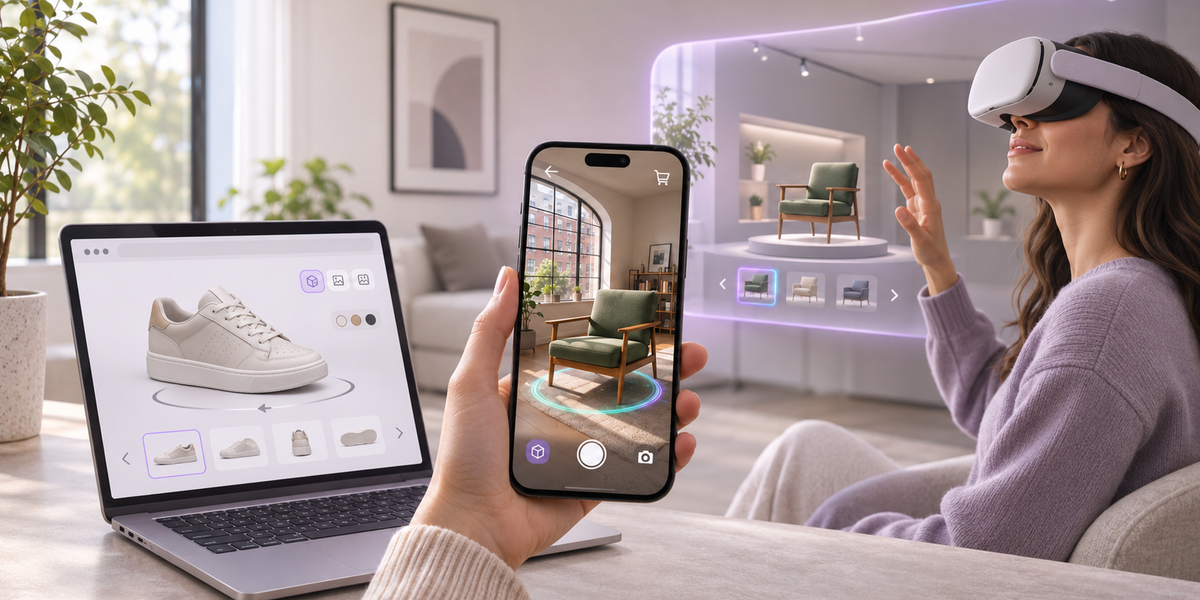
3D, AR and VR improve online shopping by closing the gap between a flat product photo and the real object a buyer will own. Interactive 3D lets people inspect materials and construction. AR places the item at true scale in their own space. VR offers deeper walkthroughs for complex products. The combination reduces hesitation, increases engagement, and, in published case studies, lifts conversion and average order value while helping cut returns driven by visual mismatch. The practical barrier for most brands has been complexity and cost. Platforms like SwiftXR remove that barrier with no-code tools that publish 3D, AR, VR and configurators directly on the product pages customers already use.
The core problem: photos force imagination
Most ecommerce product pages still ask the shopper to do the hard work. A few angles, a lifestyle shot, and a dimensions list leave them guessing about scale, finish, how the back looks, and whether it will actually fit their room or body. That uncertainty is expensive. It shows up as abandoned carts, lower conversion on high-consideration items, and returns when the product arrives and does not match the mental picture.
Furniture, modular systems, fashion, home goods, appliances and configurable products suffer most. Customers cannot fully judge them from static images alone.
What 3D does
A well-built 3D viewer gives the shopper control. They rotate the product, zoom on stitching or wood grain, check the underside or the back, and inspect how light hits different materials. When the model is accurate and loads quickly, the experience feels closer to handling the item in a store. Engagement rises because people spend more time exploring instead of trying to reconstruct the product in their heads.
What AR adds
AR takes the next step. On a phone, the customer opens the camera and places the product in their actual room, garden or desk at real-world scale. No app download is required with modern WebAR. This answers the two questions that kill the most sales in visual categories: “Will it fit?” and “How will it look here?” When the placement is true-to-scale and the model is reliable, the mental leap shrinks. Published examples consistently show higher conversion among AR users and lower rates of size- or look-related returns.
What VR contributes
VR is the deepest layer. A shopper can walk around a modular sofa system, step inside a sauna or outdoor structure, or examine a product from every angle in a dedicated virtual space. It is not necessary for every SKU, but it is powerful for high-value, complex or spatial products where seeing the full experience matters. WebVR keeps the barrier low because it runs in the browser.
Configurators multiply the effect
The biggest gains often appear when 3D, AR and VR are combined with a configurator. Shoppers change colours, materials, finishes or modules in real time and immediately see the result in 3D and in their own space. They stop imagining the product and start owning the decision before they buy. This is especially effective for furniture, modular goods, apparel with options, and any catalogue with many variants.
What the published evidence shows
Vendor and brand case studies show a consistent pattern: interactive 3D and AR experiences raise conversion and order value while reducing certain return types. These figures come from before-and-after comparisons rather than controlled A/B tests in most cases, so treat them as proof that meaningful lifts are possible rather than as guaranteed forecasts.
- EQ3 (furniture) reported a 36% increase in conversions, an 88% increase in average order value, and a 116% increase in page views after adding a 360 HD viewer and web AR. AR users converted at a 112% higher rate than non-users. Source: Cylindo EQ3 case study.
- POM (pepper spray with 72 variants) saw conversion rise from 0.82% to 3.65% and average order size increase by roughly 48% after adding a 3D configurator on Shopify. Source: Sketchfab POM case study.
- Gunner Kennels recorded a 40% increase in order conversion rate and a 5% reduction in returns after adding native 3D models and AR (measured against the prior quarter). Source: Shopify Gunner Kennels case study.
- Rebecca Minkoff found that shoppers who interacted with 3D models were 44% more likely to add to cart and 27% more likely to place an order; those who used AR were 65% more likely to purchase. Source: Shopify Rebecca Minkoff case study.
- Ace Hardware saw products with photorealistic 3D and web AR convert 21% more often than standard product pages, with shoppers spending 150% more time engaging. Source: Epigraph Ace Hardware case study.
Additional directional signals appear across platforms. Shopify has reported that products with 3D or AR content convert at substantially higher rates than those without. Other retailers have documented return reductions in the 25–40 percent range when visual mismatch was a major driver. The common thread is reduced uncertainty at the moment of decision.
Why most brands still do not do this well
The technology works. Implementation has been the obstacle. Enterprise platforms can require long sales cycles, six-figure contracts and specialist teams. Native store tools handle basic rotation and simple AR but stop short of configurators, material swaps, hotspots, advanced analytics or VR. Many mid-market brands end up with either nothing or a heavy custom build that is hard to maintain.
How SwiftXR makes immersive shopping practical
SwiftXR is built for exactly this gap. It is a no-code platform that lets ecommerce teams create, publish and measure interactive 3D, AR and VR product experiences without a 3D engineer or multi-month project.
You upload or create a model (supported formats include GLB, GLTF, OBJ, FBX and others), configure how it displays, and embed it on the product page you already have. Shoppers rotate and inspect in 3D, then tap once to place the item at real scale in their space via WebAR. WebVR is available for deeper experiences. Product configurators let customers switch colours, materials and finishes in real time, with every change updating across 3D, AR and VR.
Key advantages that remove the usual blockers:
- No app download for customers. Experiences run in the browser.
- Embeds on Shopify, WooCommerce, Wix, Webflow, WordPress and custom sites. The buying flow stays intact.
- AI-assisted creation and Gaussian Splatting support for higher realism without specialist pipelines.
- Analytics on views, engagement and interactions so you can measure what actually happens.
- Transparent pricing that starts low enough to test on a single product before expanding the catalogue.
Brands use it for furniture, fashion, accessories, appliances and other high-consideration goods. The same project can be published as a simple viewer, a configurator, AR placement or a VR walkthrough. Teams that have integrated it report higher engagement and clearer customer understanding of the product before purchase.
A practical path for most stores
Start with one product that has real options and real buyer questions. Furniture pieces, modular systems, or items with multiple finishes are strong candidates. Publish a SwiftXR experience, track conversion, average order value and returns against a control or prior period, and expand only where the numbers justify it. Because setup is no-code and embeds sit inside existing pages, the test is fast and reversible.
Frequently asked questions
Does 3D and AR actually increase conversion?
Yes in published case studies, especially for products with high visual uncertainty. Lifts vary by category and implementation quality. Measure on your own catalogue rather than assuming a universal figure.
Which products benefit most?
Furniture, modular systems, home goods, fashion with fit or finish questions, appliances and any configurable product. Simple, well-understood items with strong photography usually see smaller gains.
Do customers need an app?
No. Modern WebAR and WebVR experiences open directly in the mobile or desktop browser.
How hard is it to add this to an existing store?
With a no-code platform such as SwiftXR, you embed on the product page you already have. No rebuild of the store is required.
Does this reduce returns?
It can when returns are driven by visual mismatch or size uncertainty. Documented examples show reductions; the size of the effect depends on how much of your return volume comes from those causes.
Start with one product
Pick a single high-consideration item. Publish a 3D + AR experience (or a configurator if options matter). Measure the difference. SwiftXR is built so that test takes days, not months.
Book a SwiftXR demo or Start free with SwiftXR to see how it works on your catalogue.