Blog
September 7, 2026
·9 min readShould You Build or Buy a 3D Product Configurator? A B2B Decision Guide

Otuokon Nsikak
A business should build a custom 3D product configurator when the configurator itself is strategic, the required product behaviour is genuinely unusual, and a permanent team can own it after launch. It should buy a maintained platform when the main goal is to help buyers understand and select products without taking responsibility for a rendering engine, publishing workflow, and browser support. Many teams need a hybrid: a platform for the visual experience, connected to their existing product, commerce, or quoting systems.
The decision is not really customisation versus convenience. It is an ownership decision. Every route still needs accurate 3D assets, governed product options, a usable buyer journey, integration work, testing, and ongoing operations. The question is which responsibilities create competitive advantage and which ones simply create maintenance.
SwiftXR's point of view is that a build-versus-buy review should start with ownership boundaries, not a feature checklist. Define the buyer task, the authoritative data source, the system handoff, and the team that will run the experience. Only then compare implementation routes.
Define the three routes before comparing them
The labels build and buy can hide very different operating models.
Build a custom configurator
A custom route gives your team direct control over the experience, product logic, data model, rendering behaviour, integrations, deployment, and roadmap. That control is useful when the interaction is central to the product offer or when available platforms cannot represent the required rules.
It also means your organisation owns the full lifecycle. That includes web rendering, asset loading, mobile and browser behaviour, accessibility, analytics, security review, incident response, product-data changes, and future platform upgrades.
Buy a maintained platform
A platform supplies a maintained visual and publishing layer with defined capabilities. Your team configures the supported experience, supplies approved assets and product data, connects the intended next step, and works within the platform's documented limits.
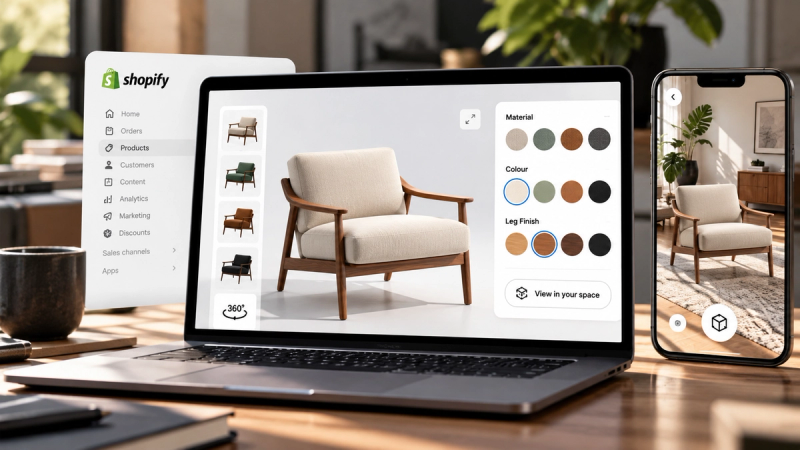
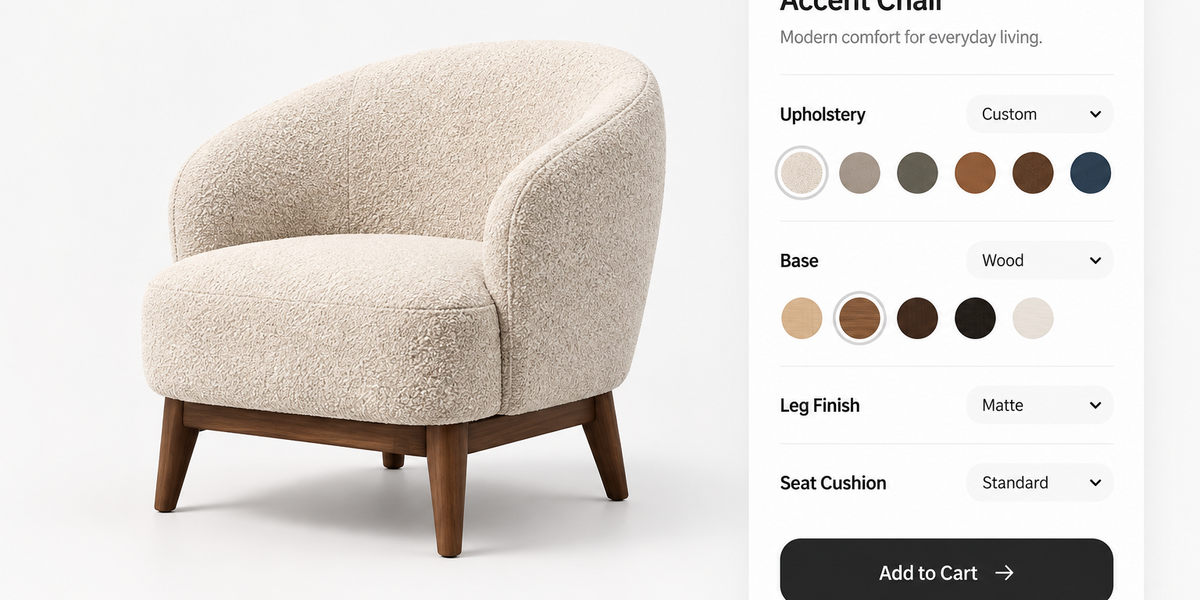
SwiftXR currently provides a browser-based product configurator with real-time colour, material, and finish changes, supported 3D and AR presentation, shareable links, website embeds, and analytics. These are useful platform capabilities, but they do not remove the need to govern product rules, source data, commercial facts, or downstream ownership.
Use a hybrid model
A hybrid route uses a maintained platform for the buyer-facing visual layer and connects it to systems that already own product, price, stock, account, quote, or order data. It can also include custom interface work around a platform when the core rendering and publishing capability does not need to be rebuilt.
Hybrid is not automatically the safest middle ground. It succeeds only when the handoff is explicit. If the platform and an internal service both become sources for the same product rule, price, or configuration state, the team has created two systems to reconcile.
Ask whether the configurator is a strategic capability
Build is easier to justify when owning the configurator technology changes how the business competes. Examples might include a novel design workflow, proprietary geometry, unusual engineering rules, or an interaction that is part of the product itself.
Do not confuse brand control with a need to own every technical layer. A maintained platform can still support a branded customer journey when its supported layout, options, and publishing routes fit the requirement. Likewise, a custom visual interface is not strategic merely because an internal team wrote it.
Write the strategic requirement in testable terms:
- Which buyer behaviour must be unique?
- Which product rule cannot be represented through a maintained platform?
- Which data or algorithm must remain inside the organisation?
- What advantage would disappear if another company used the same underlying platform?
- Which permanent team will own the capability after the launch project ends?
If those questions do not reveal a defensible reason to own the engine, buying or extending a maintained platform deserves serious consideration.
Separate visual product logic from commercial logic
A 3D configurator helps a buyer understand and select visible product options. It may show colours, materials, finishes, accessories, sizes, or approved component states. Commercial systems may separately own prices, account eligibility, discounts, stock, taxes, quote versions, and order rules.
Before choosing build or buy, create a responsibility map for every important value. The map should name one authoritative owner for:
- base products and option identifiers;
- dependencies and invalid combinations;
- geometry, materials, textures, scale, and approved views;
- market or channel availability;
- price, stock, lead time, and commercial terms;
- saved configuration identity;
- cart, quote, enquiry, or order handoff; and
- analytics, consent, and retention rules.
This distinction prevents a visual layer from quietly becoming an unmanaged copy of volatile commercial data. It also prevents a custom build from expanding until it is expected to replace catalogue, commerce, and quoting systems at once.
For a deeper boundary decision, read 3D Product Configurator vs CPQ.
Assess the 3D asset pipeline, not only the interface
The visible configurator is only one part of the operating model. Every option that changes the product may require geometry, a material, a texture, a rule, or a verified mapping to an approved identifier.
Khronos describes glTF as a royalty-free format designed for efficient transmission and loading of 3D scenes and models. That makes glTF and its binary GLB form useful delivery targets, but choosing a format does not solve asset governance. Teams still need to control scale, orientation, materials, compression, product accuracy, naming, versioning, approval, and retirement.
Compare the routes using the same representative product family. Ask:
- Can the route use the approved source assets and required delivery formats?
- Which product details must remain visually accurate?
- How are variants and material libraries created and updated?
- Can an asset revision be traced to the products and experiences using it?
- What happens when an option is discontinued or a source model changes?
- Who validates the final mobile delivery asset against the approved product?
A polished demo built from one ideal model is not evidence that the wider catalogue can be governed.
Price the operating model, not just the project
A fair comparison should cover the same scope and time horizon. Avoid comparing a platform subscription with only the initial engineering estimate for a custom build. Avoid comparing a custom implementation with a platform fee that excludes asset preparation, configuration, integration, testing, or internal operation.
Record the people and services required for each route:
- product ownership and roadmap;
- 3D asset production and quality assurance;
- product-rule and catalogue maintenance;
- design and accessibility;
- browser and device testing;
- hosting, monitoring, security, and incident response;
- commerce, CRM, CPQ, or ERP integration;
- analytics implementation and measurement; and
- support, training, release, and change management.
Do not invent a universal cost or timeline. The useful output is an explicit ownership model based on your catalogue, integrations, risk, and internal capacity.
Compare constraints before flexibility
Platform evaluations often focus on the options available in the best-case demonstration. Custom proposals often focus on what could eventually be built. Both approaches need the same constraint review.
Use a representative test pack that includes:
- a normal buyer path;
- a required option;
- an invalid combination;
- a geometry-changing option;
- a material-only option;
- a discontinued or unavailable value;
- a mobile device and realistic connection;
- a loading or integration failure;
- a fallback route to essential product information; and
- the intended cart, quote, save, share, or enquiry outcome.
The review should show what happens when the system is wrong or unavailable, not only when every input is perfect. A platform constraint is acceptable when it is understood and compatible with the buyer task. Custom flexibility is valuable only when the organisation can test and maintain it.
Use a proof of concept to test ownership
The best proof of concept is not the easiest product and not the entire catalogue. Choose one product family that exposes the real complexity without turning the test into a full rollout.
Define the proof before implementation:
- the buyer and decision;
- the permitted product states;
- the source of each option and asset;
- the minimum supported devices and destinations;
- the downstream handoff;
- the fallback experience;
- the evidence required from product, commercial, technical, and operational owners; and
- the rule for rollout, revision, or stop.
Run the same acceptance pack for a platform route and a custom prototype when both remain credible. Compare buyer task completion, delivery quality, data integrity, operating effort, and the ability to handle change. Viewer activity alone does not prove that either route supports the business decision.
The 3D product configurator requirements guide can help define the acceptance record. The 3D ecommerce pilot measurement guide explains how to keep interaction signals separate from business outcomes.
Where SwiftXR fits
SwiftXR is a buy or hybrid option when a team needs a maintained browser-based visual experience and its product options fit the supported configurator model. The current product page documents real-time colour, material, and finish changes, 3D and supported AR presentation, sharing, embedding, and analytics.
The project team should still verify its own product rules, assets, integration route, commercial facts, accessibility requirements, performance criteria, security obligations, and operating ownership. SwiftXR should not be described as the authoritative source for price, stock, complex quote policy, or manufacturing output unless a current verified implementation explicitly establishes that role.
Explore the SwiftXR 3D Product Configurator with one representative product and a written responsibility map. The right result may be platform, custom, or hybrid. The decision is sound when every critical responsibility has one owner and the chosen team can support it after launch.
Key takeaways
- Build when the configurator capability itself is strategic and a permanent team can own it.
- Buy when the supported platform model fits the buyer task and maintained delivery matters more than owning the engine.
- Use hybrid when the visual layer and authoritative business systems need different owners.
- Compare the complete operating model, including assets, integrations, quality assurance, security, and support.
- Test one representative product with failure cases and a real downstream handoff.
- Treat ownership clarity as the decision, not a longer feature list.