Blog
August 6, 2026
·5 min readBest Product Configurator Software: A Buyer's Guide for Ecommerce Brands in 2026

Otuokon Nsikak
If you sell customizable products, furniture, fashion, jewelry, electronics, or home goods, there's a quiet moment that decides most purchases: the instant a customer stops imagining and starts trusting what they see. A good product configurator is what makes that moment possible, and it can meaningfully lift conversion and cut returns by showing customers exactly what they're buying before they buy it.
The market has never had more options. That's not the hard part anymore. The hard part is finding the one built for your product, your platform, and your budget in 2026. This guide breaks down what actually matters when evaluating configurator software, and where each leading platform earns its place.
What Is a Product Configurator?
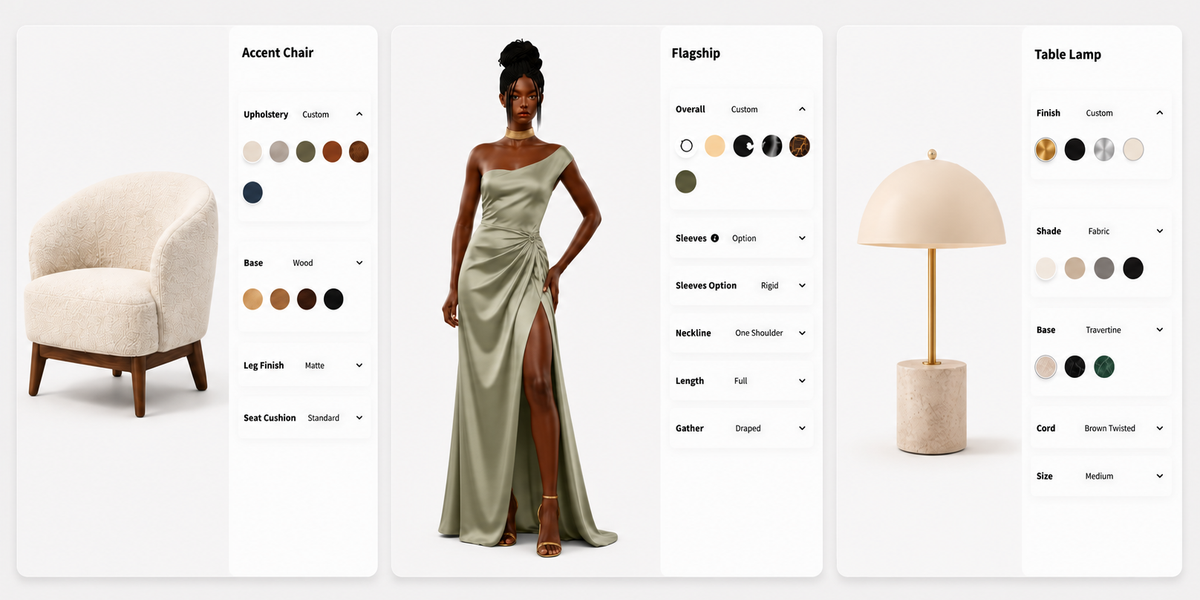
A product configurator lets customers customize a product in real time, colors, materials, sizes, accessories, and see a live 3D or AR preview before buying. The strongest platforms carry that further than visuals alone, updating pricing, tracking inventory, and generating quotes as options change.
One distinction worth knowing before you compare anything: not every "3D tool" is a configurator. Some platforms are excellent 3D viewers or design tools without configuration logic, real-time pricing, or order output at all. We'll come back to that below.
Key Features to Look For
- Real-time 3D visualization
- Browser-based AR (no app download)
- Rules-based logic (conditional options and pricing)
- Easy integration with Shopify, WooCommerce, or Wix
- AI-assisted model creation
- Mobile performance
- Analytics and reporting
Product Configurator Software Comparison
1. SwiftXR Best overall for growing DTC and B2B brands that want speed without a developer. Strengths: no-code setup, AI-assisted model creation, browser-based AR, real-time configuration, native Shopify and Wix integration. Best for: fashion, furniture, jewelry, and mid-market brands prioritizing ease of setup and time to launch.
2. Threekit Best for enterprise brands with complex, high-volume product catalogs. Strengths: high-end rendering quality, a powerful API for deep customization. Trade-offs: enterprise-tier pricing, commonly reported in the low-to-mid five figures per year and up, and a longer implementation timeline. Built for teams with dedicated technical resources, not fast self-serve setup.
3. Zakeke Best budget-friendly option for SMBs on Shopify. Strengths: affordable entry pricing, a native Shopify app, solid personalization tools for colors, text, and image uploads. Trade-offs: geared toward straightforward product personalization rather than complex, rules-based configuration. Less suited to products with deep conditional logic or made-to-order manufacturing workflows.
4. Vectary Best for teams that need a 3D or AR viewer, not a full configurator. Strengths: a strong browser-based 3D editor, a generous free tier, well suited to embedding a 3D or AR viewer on a product page. Important distinction: Vectary is a 3D design and viewing tool rather than a configurator. It has no real-time pricing logic, no conditional configuration rules, and no order or quote output. Worth considering only if your need is visualization, not customization.
5. 3D Cloud Best for large furniture and home goods catalogs at enterprise scale. Strengths: deep category-specific expertise for furniture and home retail. Trade-offs: more narrowly focused than general-purpose configurators. Its strongest fit is furniture and home specifically, with less flexibility for other product categories.
Pro tip: prioritize platforms with strong browser-based AR and no-code setup. The easier it is for your team to launch and iterate, the sooner you'll see results.
Frequently Asked Questions
What is the best product configurator for Shopify? SwiftXR and Zakeke both integrate natively with Shopify. SwiftXR suits brands that need real-time, rules-based configuration and browser-based AR, while Zakeke fits smaller sellers focused on straightforward personalization and print-on-demand.
Is there a free product configurator for ecommerce? Most platforms, including SwiftXR, offer a free tier for testing before committing to a paid plan. Vectary also has a generous free tier, though it functions as a 3D viewer rather than a full configurator with pricing and order logic.
What's the difference between a 3D viewer and a product configurator? A 3D viewer, like Vectary, lets customers rotate and inspect a product visually. A true configurator goes further: it lets customers change options in real time and updates pricing, inventory, or quotes as they do. If a platform only shows a product without letting a customer meaningfully change it, it's a viewer, not a configurator.
What's the best product configurator for furniture? SwiftXR and 3D Cloud are the strongest options for furniture specifically. SwiftXR suits brands that want fast, no-code setup and browser-based AR placement, while 3D Cloud is built for large-scale furniture and home goods catalogs at enterprise scale.
Do product configurators actually reduce returns? Letting customers see accurate scale, material, and fit before purchase tends to reduce the uncertainty that drives returns, though the exact impact varies by product category and platform. If return reduction is a priority, it's worth testing directly against your own catalog.
Choosing the Right Fit
Somewhere between a flat photo and a finished sale, there's a moment where a customer either trusts what they're looking at or doesn't. The right configurator is the one that closes that distance for your specific product, your platform, and the team you actually have to run it.
Ready to give your customers a better way to shop? Start Free Trial.
Questions? Book a call or join the community on Discord.